


What Happens to Penny Saving When the Penny Disappears

A penny used to feel like proof that every little bit counted. Drop one in a jar, pick one up from a sidewalk, round up a purchase by mistake, and the lesson was the same: small amounts add up.
Now that lesson is getting tested in a new way.
With the Trump administration moving to eliminate the penny from circulation over time, the familiar copper-colored coin sits at the center of a surprisingly personal money question. If the smallest unit of cash disappears, what happens to everyday savings? What happens to the old idea, often phrased as “a penny saved is a penny earned,” or in reverse, “a penny earned is a penny saved”?
The answer is not just about coins. It is about attention. The penny may be tiny, but it has long served as a symbol of thrift, pricing psychology, and the belief that money deserves respect at every scale.
This article is informational only and should not be taken as personal financial advice.

The penny is small, but the change feels big
For most Americans, eliminating the penny will not change the way a paycheck arrives, a mortgage is paid, or a credit card bill is settled. Digital payments can still be calculated to the exact cent. Bank balances will still show dollars and cents. Prices will still appear as $4.99, $12.47, or $199.95.
The biggest change comes at the cash register.
If pennies are phased out, cash transactions would likely be rounded to the nearest nickel. A total ending in 1 or 2 cents would round down. A total ending in 3 or 4 cents would round up. The same pattern would apply around 5 and 10.
For example:
Cash total | Rounded cash payment |
$8.01 | $8.00 |
$8.02 | $8.00 |
$8.03 | $8.05 |
$8.04 | $8.05 |
$8.06 | $8.05 |
$8.07 | $8.05 |
$8.08 | $8.10 |
$8.09 | $8.10 |
That looks simple. The emotional reaction is less simple.
People notice when money rounds up. A few cents can feel like a quiet price increase, especially for shoppers who use cash often, live on tight budgets, or track expenses closely. At the same time, rounding down gives money back in other transactions. Over many purchases, financial experts generally expect the gains and losses to be small for most households, especially if rounding happens only on the final cash total rather than each individual item.
That last point matters. If a store rounded every item separately, customers could lose more often. If the store rounds only the final total after tax, the effect is more likely to even out.
The penny’s disappearance also raises a practical distinction that many people miss: prices do not have to change just because pennies go away. A gallon of milk can still be listed at $3.99. A card payment can still clear at $3.99. Only the cash settlement needs adjustment.
Rounding to the nearest nickel changes how cash feels
Financial experts tend to view penny elimination through a few different lenses.
Economists often focus on efficiency. They point out that producing, transporting, counting, and handling low-value coins takes time and money. If a coin costs more to make and manage than it is worth in daily use, phasing it out can make sense. Many also note that other countries have removed their lowest-value coins without causing major pricing chaos.
Consumer advocates tend to focus on fairness. Rounding rules must be clear, consistent, and easy to understand. Retailers should not use the penny’s removal as cover for raising prices in unclear ways. Cash users should know exactly how totals are handled.
Personal finance educators look at behavior. The penny may vanish, but the spending habit behind it remains. A few cents here and there do not usually make or break a budget. Repeated inattention does.
The real financial issue is not whether a purchase rounds up by two cents. It is whether small spending decisions go unnoticed hundreds of times a month.
The strongest case for calm is mathematical. If rounding is neutral and applies only to final cash totals, a customer sometimes pays slightly more and sometimes slightly less. Over time, many shoppers will land close to even.
The strongest case for concern is practical. Not everyone shops the same way. A person who uses cash for small daily purchases may notice rounding more than someone who pays by card. A person buying one low-cost item at a time may have a different experience than someone buying a full basket of groceries.
That does not mean penny elimination is good or bad for every household. It means the effects depend on payment habits.
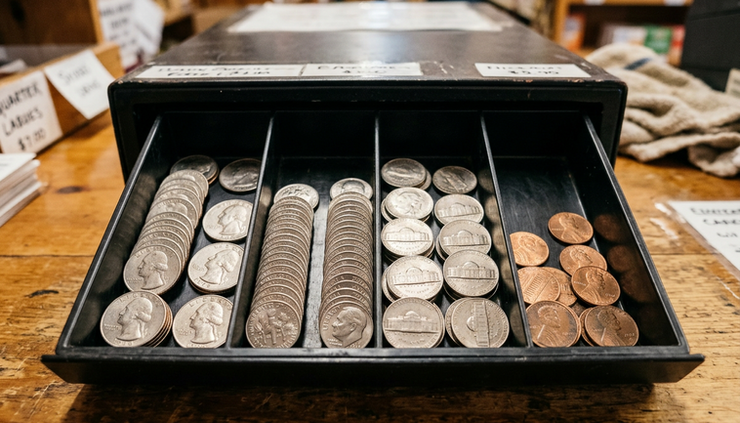
The penny has always been more than a coin
The penny’s role in American life is older than anyone’s current budget spreadsheet. It has been a teaching tool, a good-luck charm, a pricing device, and a small symbol of national identity.
Children have learned to count with pennies. Families have filled jars with them. Stores have used them to make prices look just under a round number. Charities have collected them in school drives. Phrases like “penny-pinching,” “pennies from heaven,” and “a penny for your thoughts” show how deeply the coin entered everyday language.
The phrase “a penny saved is a penny earned” is commonly linked to Benjamin Franklin, though the exact wording has shifted over time. Its message is clear enough: saving a small amount has the same practical value as earning it.
The version “A penny earned is a penny saved” flips the order, but it still points to the same habit. Income and savings are connected. Earning money matters, but what remains after spending matters too.
For generations, the penny helped make that lesson visible. A penny was small enough for a child to hold and understand. Put 100 of them together, and the lesson became tangible. Waste one, and it seemed harmless. Save one every day, and a pattern began.
That is why removing the penny feels larger than a minting decision. It touches a familiar story about thrift.
Yet history also shows that money changes. The half-cent once existed in the United States and later disappeared when it no longer fit the economy. Prices, wages, and purchasing power shift over time. A coin that once bought something meaningful can become more symbolic than useful.
The penny’s fate may be less about abandoning thrift and more about admitting that the unit no longer carries the same practical weight.
Everyday savings will rely less on coins and more on habits
If the penny disappears, penny saving does not have to disappear with it. It just becomes less literal.
The classic change jar may hold fewer copper coins. Cashiers may stop counting out exact cents. Children may learn money math with nickels instead. But the core habit remains: notice small amounts before they leak away.
The modern version of penny saving often happens through:
Automatic transfers into savings
Round-up features on debit cards or apps
Cash envelopes for weekly spending
Grocery price comparison
Canceling unused subscriptions
Choosing water instead of a paid drink
Waiting 24 hours before buying nonessential items
Those choices make the old penny lesson more powerful, not less.
A two-cent rounding difference at the register is tiny compared with a $7 impulse snack, a $15 unused subscription, or a $30 delivery fee added because dinner planning fell apart. That does not mean small coins are meaningless. It means the largest savings often come from noticing patterns, not from guarding every cent with stress.
Still, the disappearance of the penny may change how people feel about exactness. Some savers enjoy the precision of balancing to the cent. For them, rounding can feel sloppy. Others may welcome simpler cash transactions and lighter pockets.
Both reactions make sense.
The useful question is not whether every penny can still be physically saved. The useful question is whether small financial choices still get attention.

What shoppers should watch as the penny fades
A penny phaseout would likely unfold gradually. Existing pennies would not vanish overnight. They could continue showing up in drawers, jars, and old coat pockets for years. The bigger shift will be in how stores handle cash totals and how consumers respond.
The most practical move is to watch for clear rounding policies.
A fair cash-rounding system should be:
Applied only to the final total
Symmetrical, meaning it rounds down as well as up
Shown clearly on receipts
Easy for cashiers and customers to explain
Separate from card, check, and digital payments where exact cents can still be used
If a receipt shows a cash total of $12.03 rounded to $12.05, that should be visible. If a total of $12.02 rounds to $12.00, that should be visible too.
Shoppers can also decide when payment method matters. If exact cents are important for a purchase, paying with a card or digital method may preserve the exact total. If convenience matters more, cash rounding may be fine.
For people who rely on cash, the penny’s removal may be a good reason to track spending for a few weeks. Not forever. Just long enough to see patterns.
Try a simple exercise:
Keep receipts for all cash purchases for two weeks.
Note whether each total rounded up or down.
Add the rounding differences.
Compare that amount with spending on snacks, fees, subscriptions, or unplanned purchases.
Many people may find that rounding barely moves the total, while habits do. That realization is valuable.
It also brings the old saying into the present. Saving is less about the coin and more about the pause before spending.
The lesson of the penny can survive the penny
The penny helped Americans talk about thrift because it made small money visible. It sat in jars, pockets, fountains, couch cushions, and cash drawers. It turned abstract advice into something people could hold.
If it goes away, the symbol changes. The lesson does not have to.
A nickel may become the new smallest cash reminder. Digital balances may do more of the counting. Budget apps may replace coin jars for some households. Parents may teach children that five cents is the smallest coin in daily use, while still teaching that small amounts deserve care.
The risk is not that Americans will lose the penny. The risk is that people will stop noticing small financial choices because the smallest coin no longer exists.
That would be the wrong lesson.
A disappearing penny can encourage a better kind of awareness. Instead of treating thrift as a habit of saving scraps, it can become a habit of making clear choices. Spend on what matters. Question what does not. Look at totals, not only prices. Pay attention to what repeats.
The phrase “a penny earned is a penny saved” may sound quaint in a world of tap-to-pay checkouts and rounded cash totals. Yet its meaning still fits. Earning money is only half of personal finance. Keeping some of it, directing it, and respecting it still matters.

The penny may disappear from daily transactions, but penny wisdom can stay. The next time a total rounds up or down, let it be a prompt rather than an irritation. Look beyond the two cents. Notice the habits around the purchase.
That is where the real savings usually live.


Comments